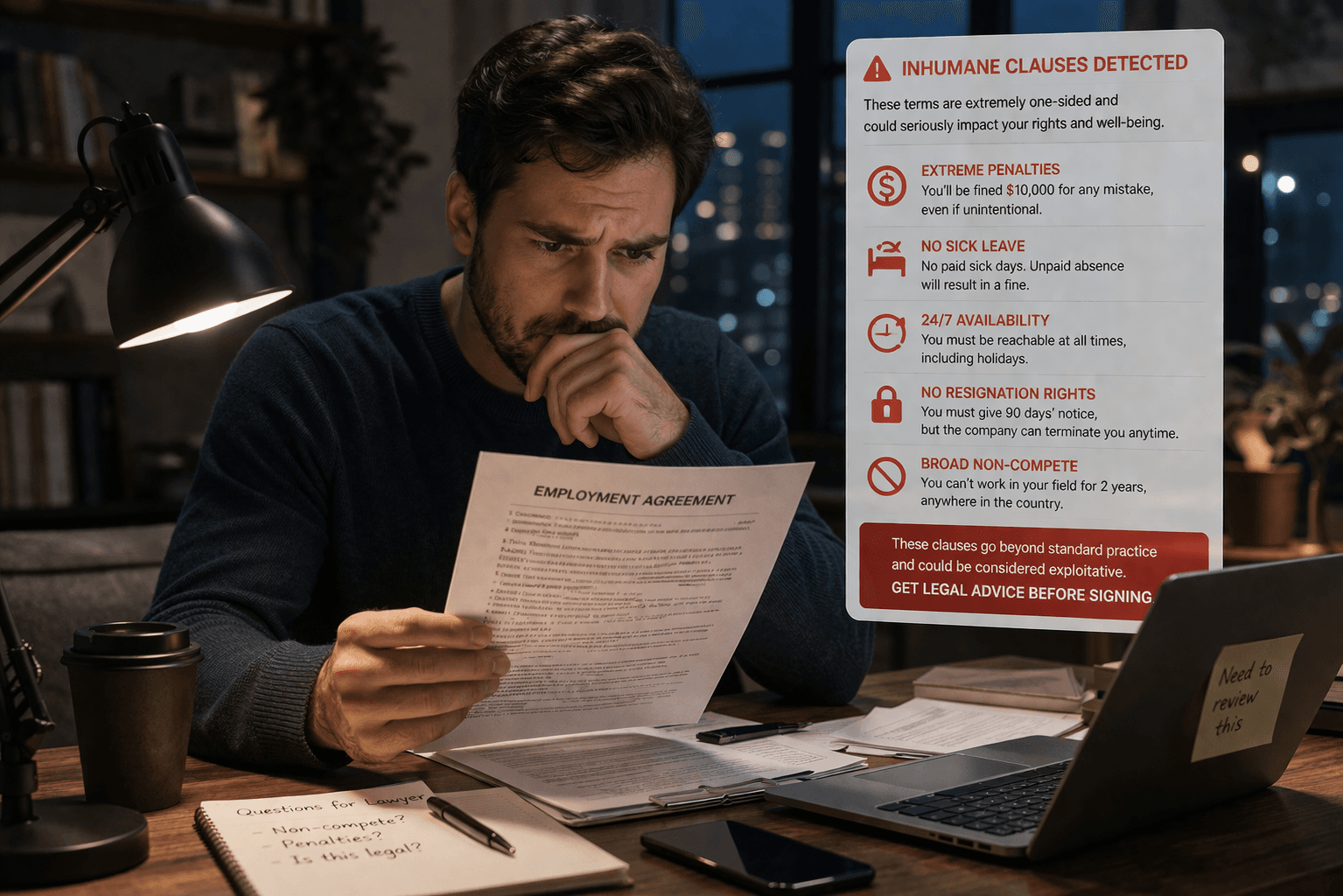
Legal Contracts
Some contracts contain clauses that go beyond standard practice.
SecondLayer finds the extreme penalties, one-sided terms, and hidden obligations that could seriously impact your rights.
Analyse My Contract →How to identify a one-sided contract
Legal contracts can be technically enforceable while still being highly unfair in practice. SecondLayer identifies clauses that deviate from what would be standard in a balanced agreement of that type.
Disproportionate Penalty Clauses
Penalty clauses that significantly exceed the actual loss caused by a breach are a classic red flag. We identify penalty provisions and flag where the amount appears disproportionate to the obligation it enforces.
Unilateral Variation Rights
Clauses that allow one party to change the terms of the agreement unilaterally — without your consent — are among the most problematic. We surface any provision that gives the other party the right to modify prices, services, or obligations without notice.
Asymmetric Rights and Obligations
Contracts where one party has extensive rights and the other extensive obligations — with no corresponding balance — are inherently one-sided. We map the obligations on each side and flag material asymmetries.
Exclusion of Statutory Rights
Some contracts attempt to exclude statutory rights you cannot legally waive. In consumer contracts under Irish law, provisions that exclude statutory consumer protections are automatically void — but they still appear. We identify them.
Vague Obligation Language
Obligations described as "reasonable efforts", "best endeavours", or "commercially reasonable" have very different legal meanings. We explain what each formulation actually requires and where the ambiguity creates risk.
Missing Standard Protections
A well-drafted contract of any type includes certain standard protections for both parties. We identify what's absent that you would reasonably expect — and flag where that absence creates significant risk.
Common questions
What makes a clause legally unfair?
Under Irish and EU law, unfair terms in consumer contracts are those that create a significant imbalance in parties' rights and obligations to the detriment of the consumer. SecondLayer identifies clauses that fit this pattern — though whether a specific clause is legally enforceable ultimately requires legal advice.
Can I refuse to sign if I find problematic clauses?
That's entirely your decision. SecondLayer provides the information you need to make that decision — identifying exactly which clauses are problematic, what they mean, and what risk they create. What you do with that information is up to you.
What types of legal contracts can SecondLayer analyse?
Any contract with written terms — lease agreements, purchase agreements, service contracts, loan agreements, settlement agreements, and more. SecondLayer is not specific to any contract type.
Should I still get legal advice after using SecondLayer?
For high-stakes contracts — property purchases, significant business commitments, legal settlements — yes. SecondLayer helps you understand what the contract says and identifies the areas of highest risk. A solicitor can advise on enforceability and negotiation strategy.
SecondLayer analyses document content and surfaces information to help you understand what your document says. This is not legal, financial, or insurance advice. Always consult a qualified solicitor, financial advisor, or insurance broker before making decisions based on any document analysis.
Find what's hidden before you sign
Upload any contract and get a plain-English breakdown of the risks, obligations, and clauses that matter.
Analyse My Contract →